

Economic Evaluation Standards
On this page, explore…

Standards for the Economic Evaluation of Educational and Social Programs
From 2020-2021, the Cost Analysis Standards Panel was convened by AIR (American Institutes for Research) to establish a set of written standards for economic evaluation in education. 15 experts in the economic evaluation of social programs developed the Standards for the Economic Evaluation of Educational and Social Programs. CAP Project, with funding from the U.S. Department of Education’s Institute of Education Sciences, is currently developing resources to support cost analysts and others in meeting these standards.
Economic Evaluation Standards Checklist (EESC)
Introduction
The Economic Evaluation Standards Checklist (EESC) is an Excel-based tool developed between 2025 and 2026 with funding from the Institute of Education Sciences of the U.S. Department of Education.
The purpose of the EESC is to help users plan a high-quality cost analysis or cost-effectiveness analysis, or evaluate an existing study to determine the extent to which it meets the Standards for the Economic Evaluation of Educational and Social Programs. These standards were established by the Cost Analysis Standards Project in 2020-21 with the goal of improving the quality of information available to inform decision-making about our education system. The standards aim to increase the rigor, transparency, and comparability of economic evaluations of educational and other social programs.
How the EESC Can Help You

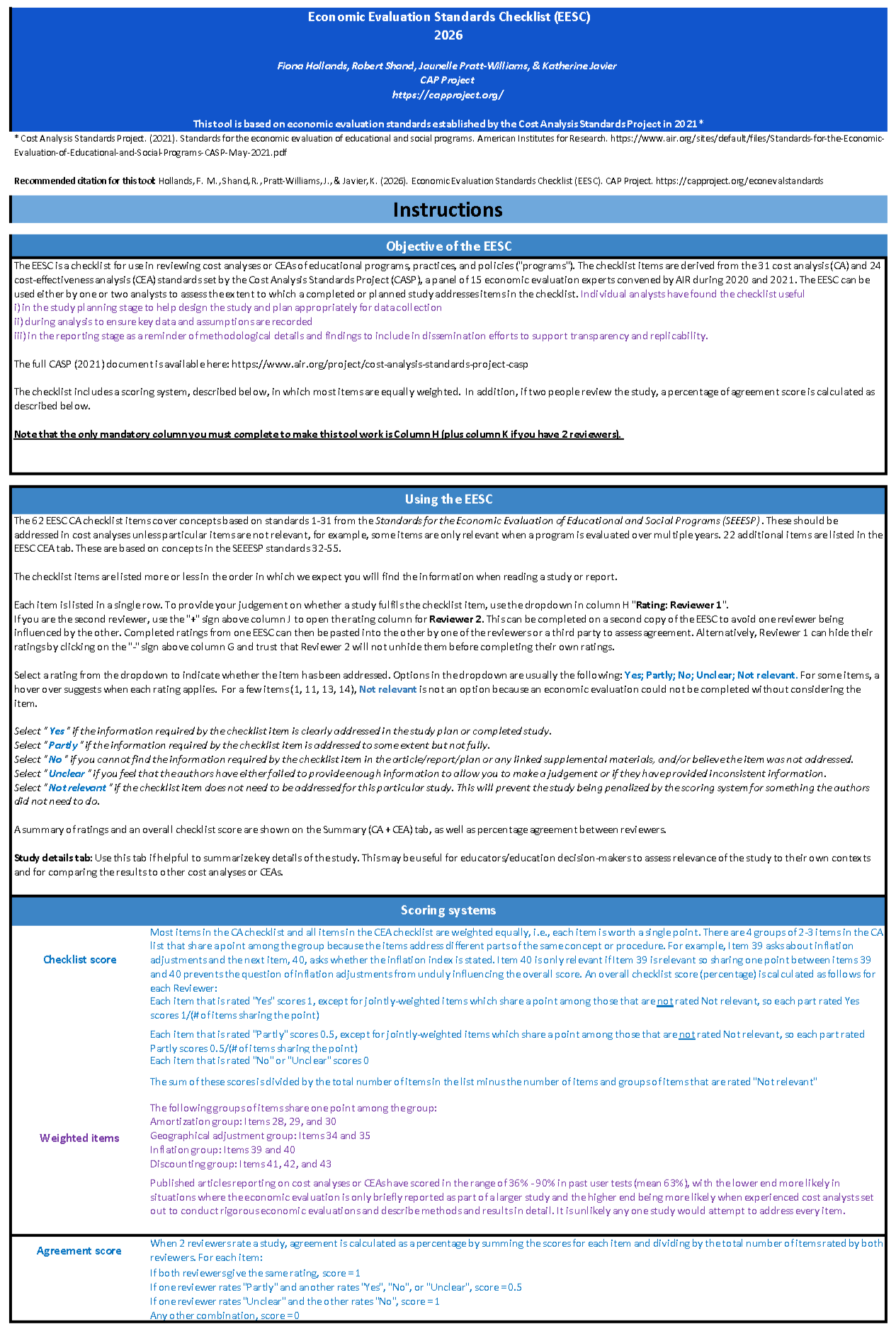
The EESC serves as a practical application of the Standards for the Economic Evaluation of Educational and Social Programs by listing items that analysts should address in a cost analysis or cost-effectiveness analysis (CEA), and allowing users to rate the extent to which a plan or study addresses each item.
The EESC can help you:
Plan a cost analysis or cost-effectiveness analysis of your own.

Document your study methods and analytical choices while your study is in progress.

Make adjustments before you complete your study to ensure you are meeting the standards to the greatest possible degree.

Evaluate a completed study to assess its quality and determine whether you can use the results to inform a decision, or to compare with the results of other economic evaluations.

EESC Video Tutorial
Watch a brief video tutorial on how to use key EESC features including:
Overview of EESC (00:00)
Instructions Tab (00:00)
Study Details Tab (00:00)
CA Items Tab (00:00)
Checklist Scoring Table (00:00)
CEA Items Tab (00:00)
Summary (CA + CEA) Tab (00:00)
Use of the EESC by a Second Reviewer (00:00)
Practical Approaches to Using the EESC
In this section, learn:
Two strategies for completing the EESC
How to provide evidence to support your ratings
How to use the EESC to evaluate a plan vs. a study
Limitations of the EESC
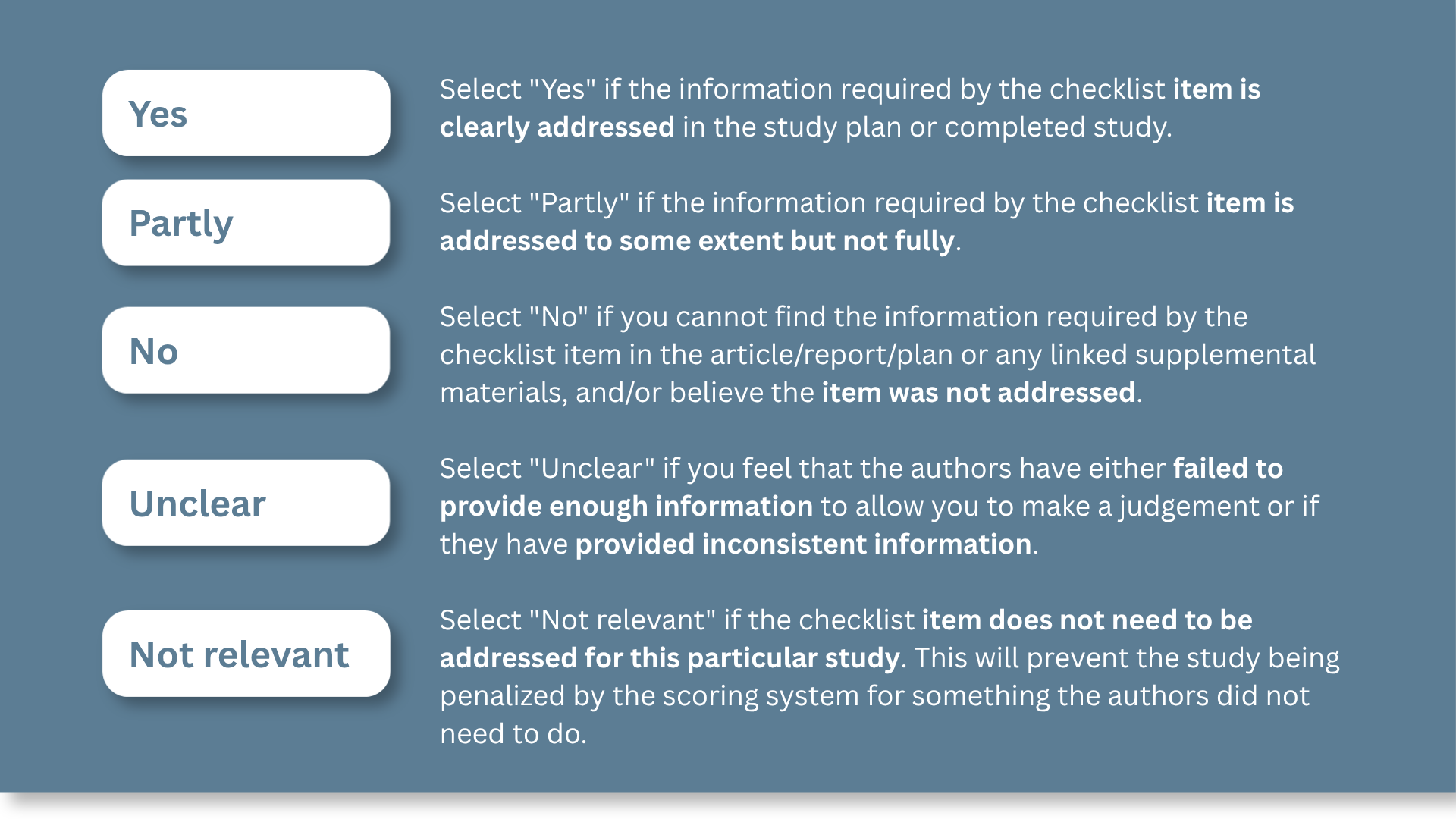
How to Complete the EESC Ratings (2 Strategies)

Start by looking through the list of items in the EESC to prime yourself with the information you should be looking for in a study or plan. This information is in column E on the CA items and CEA items tabs.

-
Read the study or plan in its entirety before beginning to rate. This includes reviewing any supplemental materials and appendices. As you read, you can highlight information that is relevant to any of the EESC items. Once you are done reading, begin rating from the top of the checklist and refer back to the study as needed, especially to gather material for your rating explanations.
The advantage of this approach is that you have seen all the information the authors provide before you start rating. This reduces the likelihood you will need to revisit your judgments. The disadvantage is that you may end up having to read the article 2-3 times to find everything you need. One trick that may help is, on the first read, strike out any long sections of text that have no information relevant to the economic evaluation. That way you’ll have a lot less to read the second and third times.
-
Start reading and rating at the same time. This feels faster, but the downside is that you are making judgments based only on what you have read so far and may often need to revise a rating and rating explanation as you acquire more information. For example, you may expect a lot of the analytical items to be addressed in the methods section, but sometimes an issue is unexpectedly addressed later in the results, discussion, and even the limitations sections where authors may clarify what they did or did not do.
Completed Examples of the EESC
Coming Soon!
Providing Evidence to Support Your Rating
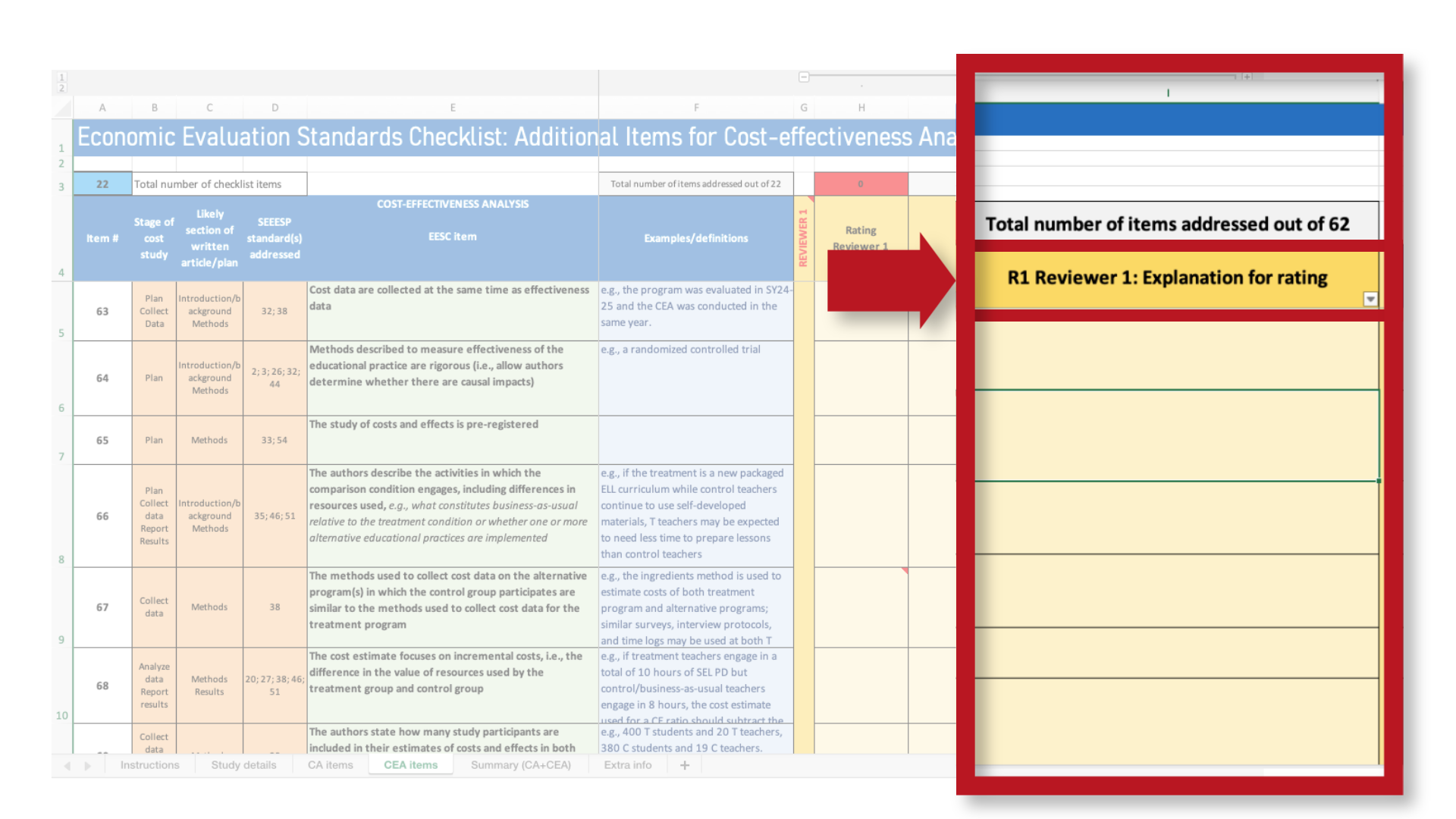
In the “Explanation for rating” column (Column I), it can be helpful to put the page number or section heading where you found the information, plus a short note to explain your assessment, e.g., what the authors did well or what you found unclear. You can copy and paste relevant text from the article to support
your rating, keeping in the back of your mind what the study authors themselves might like to understand about the reasons for your rating, or what might be important for a decision maker to consider. You can check out the 2 completed EESC examples posted on this webpage (coming soon!).
Using EESC to Evaluate a Plan vs. a Study
If you are applying the EESC to evaluate a plan you’re putting together for an economic evaluation, it would make sense for you to use the “Explanation for rating” column to jot down how you’re planning to address the item or to note issues that still need to be discussed among the research team or with the audience for the study.
Limitations of EESC
Although we have weighted most EESC items equally, any cost analyst will tell you that some of these checklist items are more important than others in determining the quality of a cost analysis. We did consider giving greater weight to some items, but ran into two obstacles: first, cost analysts don’t agree with each other about which items are most important; secondly, the importance of certain items will vary from study to study depending on the goals of the study and on the interventions being studied. As a result, beyond weighting items related to a single procedure (like amortization) such that they share a point, and effectively weighting any item rated “Not relevant” at 0, we have refrained from imposing weights.
A second limitation of the checklist when applied to a study you did not co-author, is that you can only make judgments based on what the authors put in print. Many journals and funders impose strict page limitations that preclude detailed explanations of cost analysis methods, especially given pre-existing expectations for reporting other aspects of a study. The result is that you may underestimate the quality of the authors’ work by judging what they report rather than what they actually did. But now that many journals allow appendices, supplemental online materials, and links to repositories, there is a greater chance that details of the cost analysis are provided, and possibly even the analysis itself.
Frequently Asked Questions
-
Across 23 journal articles that we evaluated using an earlier version of the EESC, the average percentage of items we rated Yes or Partly was 61% for the CA items and 58% for the CEA items (not including the optional/advanced items). In every case, we rated some items Not relevant (averaging 17% of the CA items and 22% of the CEA items) and, for all but one article, we rated a few items Unclear (averaging 7% of the CA items and 6% of the CEA items).
80% of items rated Yes or Partly would be a good score to aim for.
-
Across the same 23 articles we evaluated using the EESC, the range of overall scores was 33% - 89% for the CA items, averaging 61%. For the CEA items, the range of overall scores was 36% - 91%, averaging 65%.
-
A second reviewer is useful when the stakes are high, such as when the checklist is being used to prepare or evaluate a grant application or a journal submission.
-
This varies depending on the clarity and complexity of the article, and the extent to which the user spends time gathering and writing up information to support their ratings. If the author knows the study well, ratings may be completed in less than an hour. However, to document one’s ratings carefully for a study authored by someone else, the average user has taken approximately 7 hours. It is likely that you can use AI to speed up the process of identifying the information on which to base your rating. But, at least for now, your judgment in selecting the appropriate rating for each item is likely to be more valuable than that of an AI app.
-
Two-way agreement rates for ratings, calculated by scoring agreement on each item, average around 73% before discussion/sharing rating explanations, and 96% after discussion.
-
Each reviewer should read the other reviewer’s explanation for their rating. If this does not prompt them to agree with each other, they should discuss the rating and revisit the evidence used to support that rating.
-
Most articles or reports include an email address for the lead author who can be contacted with questions about their analysis. Explain how you will use the information you are requesting and why you need it. However, if the authors did not carefully document all their analytical choices when conducting the study, they may not be able to answer your questions at a later date.

Cost Analysis Standards Template
The Cost Analysis Standards Template is an Excel-based tool that lists the 31 cost analysis standards and 24 CEA standards from the Standards for the Economic Evaluation of Educational and Social programs, allowing one or two researchers to evaluate a cost analysis/CEA plan, report, or publication against each one and providing an overall assessment of the economic evaluation.